
Best Law Practice Management Platforms for Three-Way Trust Account Reconciliation
admin
September 18, 2026
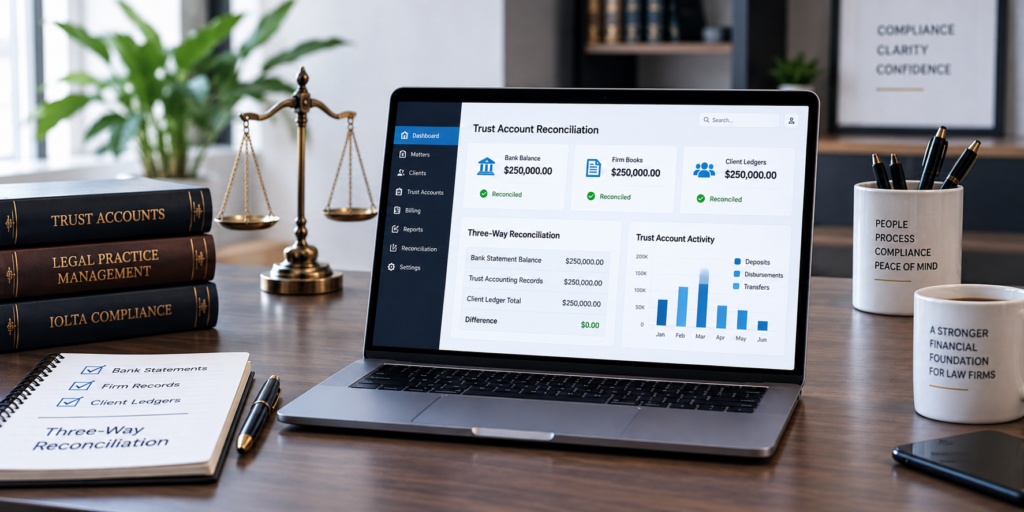
Best Law Practice Management Platforms for Three-Way Trust Account Reconciliation
Three-way trust account reconciliation is one of the most important financial processes for a law firm handling client funds. It requires the firm’s trust account records, client-level trust ledgers, and bank records to agree.
The right three-way reconciliation software can make this process easier by connecting trust accounting, client ledgers, bank transactions, billing, and reporting in one workflow.
However, not every law firm needs the same type of platform. Some firms prefer an all-in-one legal practice management system, while others want to keep QuickBooks Online as their general ledger and add legal-specific trust accounting software.
This guide looks at the major platform approaches and the features law firms should evaluate before choosing software for three-way trust account reconciliation.
What Is Three-Way Trust Account Reconciliation?
Three-way reconciliation compares three sets of records:
- The trust bank account balance
- The firm’s trust accounting records
- The individual client trust ledger balances
The objective is to confirm that these three records agree after accounting for appropriate outstanding transactions.
For example, an IOLTA account may hold funds belonging to multiple clients. Each client’s balance needs to be tracked separately while the total client balances reconcile with the firm’s trust records and the adjusted bank balance.
Because trust accounting requirements can vary by jurisdiction, law firms should also verify the applicable state bar rules and reconciliation frequency.
For firms that need professional support with this process, three-way trust account reconciliation is an important part of maintaining accurate trust accounting.
Make Better Financial Decisions for Your Law Firm
Get expert law firm accounting services to turn financial reports into clear, actionable insights for your firm.
What Should Three-Way Reconciliation Software Include?
Before comparing platforms, it is important to understand which features actually matter.
Good three-way reconciliation software should make it easier to manage:
- Trust and operating account separation
- Individual client trust ledgers
- IOLTA accounting
- Bank transaction matching
- Three-way reconciliation reports
- Trust deposits and disbursements
- Transfers from trust to operating accounts
- Legal billing
- Client matter accounting
- Financial reporting
- Audit trails
- Data exports and integrations
The software should also fit the firm’s existing accounting workflow. A platform that looks comprehensive but creates additional manual reconciliation work may not solve the underlying problem.
1. Clio: Practice Management With Trust Accounting
Clio is a widely used legal practice management platform that combines matter management, billing, payments, and trust accounting capabilities.
Its trust accounting tools allow firms to maintain separate trust and operating ledgers, manage transactions connected to matters and clients, and reconcile trust transactions against bank statements. Clio also provides trust-account reports and supports three-way reconciliation through its accounting tools.
Clio can also integrate with QuickBooks Online and Xero, which may be useful for firms that want legal practice management alongside an existing accounting ecosystem.
Clio may suit firms that want:
- Broad practice management functionality
- Matter and client management
- Legal billing
- Trust accounting
- Online payments
- Accounting integrations
- Cloud-based workflows
The important consideration is whether the firm’s accounting requirements are adequately covered by its selected Clio setup and integrations.
2. CosmoLex: Integrated Legal Accounting and Practice Management
CosmoLex takes a more accounting-centered approach. Its platform combines practice management with business accounting, trust accounting, billing, and client matter management.
CosmoLex states that its trust accounting functionality includes separate trust accounts, automatic transfers, bank statement imports, and one-click three-way reconciliation reporting.
This type of integrated structure can be useful for firms that prefer to keep legal accounting and practice management within one platform instead of maintaining several disconnected systems.
CosmoLex may suit firms looking for:
- Built-in trust accounting
- Three-way reconciliation
- Legal billing
- Business accounting
- Matter-level accounting
- Practice management
- Financial reporting
Law firms should still evaluate how the platform fits with their accountant’s workflow, existing software, reporting requirements, and state-specific trust accounting procedures.
3. LeanLaw + QuickBooks Online
Another approach is to keep QuickBooks Online as the firm’s accounting system and add a legal-specific platform for billing and trust accounting.
LeanLaw is an example of this model. It works alongside QuickBooks Online, allowing firms to combine legal billing and trust workflows with a general accounting platform.
This approach may be attractive to firms that already rely heavily on QuickBooks Online and want to retain their existing accounting environment.
The trade-off is that firms need to carefully evaluate the integration between the legal platform and accounting system. The more systems involved, the more important data synchronization, transaction mapping, and reconciliation processes become.
4. Tabs3 and Dedicated Legal Accounting Workflows
Tabs3 is another established option for firms looking for dedicated legal accounting and practice management functionality.
Its trust accounting documentation includes a Three-Way Reconciliation Report comparing client trust ledger balances, the adjusted bank balance, and the check register balance.
This illustrates an important point when evaluating three-way reconciliation software: do not simply look for a platform that mentions “trust accounting.” Check whether it can actually produce the reconciliation reports and records your firm’s workflow requires.
Three-Way Reconciliation Software Comparison
| Feature | Clio | CosmoLex | LeanLaw + QuickBooks | Tabs3 |
|---|---|---|---|---|
| Legal practice management | Yes | Yes | Depends on stack | Yes |
| Trust accounting | Yes | Yes | Yes through legal workflow | Yes |
| Three-way reconciliation | Yes | Yes | Supported through integrated workflow | Yes |
| Client-level trust ledgers | Yes | Yes | Yes | Yes |
| Legal billing | Yes | Yes | Yes | Yes |
| General accounting | Clio Accounting / integrations | Built in | QuickBooks Online | Legal accounting |
| QuickBooks integration | Yes | Available | Core architecture | Available depending on setup |
| Best evaluated for | Broad legal workflow | Integrated accounting | QBO-centered firms | Dedicated legal accounting |
The table should be treated as a starting point rather than a universal ranking. Product features, plans, integrations, and availability can change, so firms should verify current capabilities directly with each provider before purchasing.
Get More Clarity From Your Law Firm’s Finances
Explore accounting services for law firms designed to help you understand financial performance and plan with confidence.
What Makes a Good Trust Accounting Platform for Law Firms?
The most important factor is not the number of features. It is whether the platform supports the firm’s actual trust accounting workflow.
1. Client-Level Trust Ledgers
Every dollar held for a client should be properly attributed to that client or matter.
A good system should make it easy to see individual client balances and transaction history.
2. Automated Bank Reconciliation
Bank feeds and transaction matching can reduce manual data entry and make discrepancies easier to identify.
However, automation should support—not replace—review procedures.
3. Three-Way Reconciliation Reports
The platform should make it possible to compare the bank balance, trust accounting records, and individual client balances.
This is one of the most important features to verify during a software demonstration.
4. IOLTA Support
If your firm maintains an IOLTA account, confirm that the software supports the relevant trust-account structure and reporting requirements.
Firms that need additional help with this area can also review IOLTA trust accounting services.
5. Legal Billing Integration
Trust accounting does not operate in isolation.
When earned fees are transferred from trust to operating accounts, the billing and trust accounting workflows need to remain consistent.
6. Audit Trails and Reporting
A good system should make it easier to understand who entered transactions, when they were entered, and how balances changed.
Reporting capabilities are particularly important when preparing for internal reviews or responding to accounting questions.
Know Your Numbers. Grow Your Firm.
From financial reporting to bookkeeping, Ethnum helps law firms manage their finances with greater clarity and confidence.
Should Law Firms Use General Accounting Software for Trust Accounts?
General accounting software can be useful for a law firm’s operating finances, but trust accounting has additional requirements.
A general ledger alone may not provide the client-level trust accounting, matter tracking, and legal-specific reconciliation workflows that a law firm needs.
For that reason, firms should carefully evaluate whether their accounting system includes legal trust functionality or whether a legal-specific platform should be added.
This is also why law firm bookkeeping services should understand the difference between ordinary business bookkeeping and legal trust accounting.
How Three-Way Reconciliation Software Can Reduce Manual Work
Manual reconciliation often involves exporting transactions, comparing spreadsheets, checking client balances, and investigating differences.
Integrated software can reduce some of this repetitive work by connecting bank transactions, trust ledgers, client matters, and accounting records.
For example, Clio describes bank-feed matching and direct reconciliation within its accounting workflow, while CosmoLex provides built-in three-way reconciliation reporting.
The goal should not simply be automation. The goal is a workflow where transactions are recorded correctly, discrepancies can be identified, and supporting records remain accessible.
How Should a Law Firm Choose Between Platforms?
Instead of choosing software based only on popularity, law firms should evaluate their specific requirements.
Ask these questions before making a decision:
- Does the platform support three-way reconciliation?
- Can it maintain individual client trust ledgers?
- Does it support IOLTA accounts?
- Can it separate trust and operating funds?
- How does it handle trust-to-operating transfers?
- Does it integrate with QuickBooks Online or another accounting system?
- Can accountants access the necessary financial information?
- What reports are available?
- Can historical records be exported?
- What audit trails are maintained?
- Does the platform support the firm’s jurisdiction-specific requirements?
- How easy is it to train staff?
The answers will often matter more than the software’s overall feature count.
How Bookkeeping and Reconciliation Work Together
Even the right software does not eliminate the need for accurate bookkeeping.
Transactions still need to be categorized correctly, client funds need to be assigned to the right matters, and discrepancies need to be investigated.
If historical records contain errors, software alone may not resolve them.
In those situations, law firm bookkeeping cleanup may be necessary before moving to a more automated workflow.
Similarly, firms should consider how their reconciliation process connects with law firm financial reporting services.
Why State Trust Rules Matter When Choosing Software
Trust accounting requirements are not identical across every U.S. jurisdiction.
A firm’s software should therefore be evaluated against the requirements that actually apply to its practice.
Ethnum’s state trust account rules resource can be useful as a starting point when reviewing state-specific trust accounting considerations.
Law firms should also consult their applicable state bar rules and qualified professionals for current compliance requirements.
Need Help Understanding Your Firm’s Financials?
Learn how Ethnum’s law firm accounting services can help you maintain accurate reports and make informed financial decisions.
What About State-Specific IOLTA Accounting?
A multi-state firm may have additional considerations when managing trust accounts across jurisdictions.
For example, firms can review state-specific resources such as California IOLTA accounting services, Washington IOLTA accounting services, and Utah IOLTA trust accounting compliance.
The software selection process should account for the jurisdictions where the firm actually operates rather than assuming that one configuration works identically everywhere.
Final Thoughts on Three-Way Reconciliation Software
The right three-way reconciliation software depends on how a law firm manages practice management, trust accounting, billing, and general accounting.
Clio may be relevant for firms looking for a broad legal practice management ecosystem with trust accounting capabilities. CosmoLex may appeal to firms that want integrated legal accounting and practice management. LeanLaw’s QuickBooks-centered approach may suit firms that want to retain QuickBooks Online as part of their accounting workflow. Tabs3 is another option for firms evaluating dedicated legal accounting functionality.
Rather than selecting a platform solely because it is widely used, law firms should test the actual trust accounting workflow.
The most important questions are simple: Can the system maintain accurate client ledgers? Can it reconcile the bank, books, and client balances? Can it produce the reports the firm needs? And can the accounting workflow be managed consistently?
For firms reviewing their broader financial operations, learn how Ethnum works or contact Ethnum to discuss bookkeeping, trust accounting, reconciliation, and financial reporting requirements.
Frequently Asked Questions
What is three-way reconciliation software?
Three-way reconciliation software is legal accounting or practice management software that helps compare a law firm’s trust bank balance, internal trust accounting records, and individual client trust ledger balances.
What software is used for three-way trust reconciliation?
Several legal platforms provide three-way reconciliation capabilities, including Clio, CosmoLex, and Tabs3. Other workflows use a legal-specific platform alongside QuickBooks Online. Firms should verify current features and jurisdiction-specific requirements before selecting software.
Does QuickBooks Online perform three-way trust reconciliation by itself?
QuickBooks Online is a general accounting platform, so firms should evaluate whether its standalone capabilities meet their legal trust-accounting requirements. Some firms pair QuickBooks Online with legal-specific software to add trust accounting and reconciliation workflows.
Why is three-way reconciliation important for law firms?
Three-way reconciliation helps confirm that trust bank records, the firm’s accounting records, and individual client balances agree. It provides an important control for accurate management of client funds and supports applicable trust-accounting requirements.
What should law firms look for in trust accounting software?
Law firms should evaluate client-level ledgers, IOLTA support, three-way reconciliation, bank feeds, audit trails, trust-to-operating transfers, legal billing integration, reporting, integrations, and support for applicable jurisdictional requirements.
Turn Your Law Firm’s Financials Into Better Decisions
Get clear, accurate financial reporting with accounting support built specifically for law firms.
The Ethnum Team is the legal-finance accounting team behind Ethnum — providing specialized accounting solutions for law firms and legal professionals. Drawing on experience in legal accounting and financial management, the team creates practical resources covering trust accounting, three-way reconciliation, legal billing, compliance, and law-firm financial operations. Ethnum helps law firms maintain accurate financial records, streamline accounting processes, and make informed financial decisions with confidence.
Recent Post


About Us
We help businesses grow through strategic consulting, innovative solutions, and result-driven execution.
2 Responses